Tuesday, December 4, 2018

U.S.-China Trade Truce Gives Both Sides Political Breathing Room


President Trump and President Xi Jinping of China have put a pause to the current trade war between the U.S. and China. This agreement does little to actually resolve the differences between the two countries and is rather meant to create some political breathing room for the two Presidents. The trade war has negative impacts on both the U.S. and China as we see both economies beginning to show more weaknesses. This agreement doesn't reverse the tariffs on $250 billion in Chinese goods but only prevents the tariffs from being increased. The existing tariffs are unlikely to be removed until China has "kept its promises of wholesale structural changes." The current point of conflict is the automobile industry where the Chinese are planning to enter the American market. President Trump's stance on this issue is focused on preventing heavy job losses in the automobile industry.

1. Do you think this is a step towards repairing the relationship between the two countries or is it just a pause on the conflict?

2. Will the 90 days of trade talks result in any change being made in either country?

3. Is the American economy being protected by these tariffs or are these tariffs weakening it?

Friday, November 16, 2018

CNN’s Jim Acosta Returns to the White House After Judge’s Ruling

https://www.nytimes.com/2018/11/16/business/media/cnn-acosta-trump.html?action=click&module=Top+Stories&pgtype=Homepage


CNN filed a lawsuit against the president and members of his administration when Jim Acosta, a reporter from CNN, was stripped of his press badge shortly after last week's post-midterms press conference. On Friday, Judge Timothy J. Kelly ordered the Trump administration to restore Acosta's press credentials for violation of his right to a fair and transparent process. However, Judge Kelly did not rule that the First Amendment was violated nor did he rule whether Acosta's rude behavior was right or wrong. The ruling simply stated the president can not revoke Acosta's credentials without due process ("a statement of what he did wrong, an opportunity to respond, a final decision"). As a result of Acosta's victory in court, President Trump has announced that the White House will tighten its rules and processes for reporter conduct in order to ensure orderly press conferences and decorum in the White House. CNN vs. President Trump explicitly demonstrates the dynamic between the press and the president. 

1. "During the hearing, Judge Kelly appeared to agree with the argument put forth by the administration’s lawyers that the First Amendment did not guarantee a right to enter the White House campus." In addition, press conferences are by invitation. Is getting a press pass a privilege or a right? Is the CNN vs. President Trump case truly an issue of the First Amendment (free press)? Why or why not? 

2. Acosta's press pass was removed because of his aggressive behavior and for inappropriately touching a White House intern during the press conference. Do you think the choice to remove Acosta's press credentials was justified? If an individual is dangerous/disruptive during a press conference, should the White House be able to remove the person from the premise without due process? 

3. How does the media shape the public's views of the presidency? What evidence has or has not shown that the news media is intent on hurting President Trump's administration? To what extent should the president and his administration be able to hold secrets from the public/press? 


Sunday, November 11, 2018

Gun Rights Advocates Lose Ground to Gun Control Proponents


https://www.cnbc.com/2018/11/09/gun-control-is-winning-issue-in-midterms-as-advocates-gain-in-house-defy-nra.html

After heavy discussion on the issue, gun control proponents obtained more seats in the House in the midterm election races while gun rights protagonists lost them. According to the House voting records tracked by the National Rifle Association (NRA), more than two dozen gun rights campaigners will not be returning to Congress. The new majority consists of gun control supporters and 17 of the newly elected House Democrats back stricter gun laws. Even with a decline in campaign spending by the NRA, campaign contributions to gun control supporting candidates surged. Giffords, the political action committee formed by former Arizona congresswoman Gabby Giffords spent nearly $5 million and Everytown for Gun Safety pledged $30 million to this year's election. Although the gun control movement is gaining momentum, the enactment of control on weapons or ammunition will continue to be a continuous uphill battle with a Republican-controlled Senate and a President who remains an ally to the NRA. Vowing for a range of actions to stem gun violence, Rep. Nancy Pelosi of California stated that "The American people deserve real action to end the daily epidemic of gun violence that is stealing the lives of our children on campuses, in places of worship and on our streets".

1) What do you think the NRA will do to counteract the momentum of gun control?

2) What actions do you think the new majority will pass that the old majority did not?

3) Do you think this will make a big impact to decrease the likelihood of future gun violence events?

Democrats take the House, Republicans keep the Senate

https://www.nytimes.com/2018/11/06/us/politics/election-day.html In the recent midterm elections, the Democrats have gained control of the House, while the Republicans have maintained control of the Senate. Partisanship in America is still clearly seen because the Democrats were able to take the seats from Republicans in districts that have educated voters. The Democratic win the House was not certain, but they were able to win key races in Iowa, Texas, Virginia, Kentucky, Florida, New York, and Illinois to gain the majority. Republicans were able to win the Senate in key races with Mike Braun in Indiana, Marsha Blackburn in Tennessee, Ted Cruz in Texas, Kevin Kramer in Tennessee, Jack Rosen in Nevada, and Josh Hawley in Missouri. This election has become historic because the candidates chosen have been the most diverse in US history. For example, Jared Polis was “the first openly gay man elected as governor,” Ilhan Omar and Rashida Tlaib were “the first Muslim women elected to Congress,” and Sharice Davids and Deb Haaland were “the first Native American women voted in to the House.” The biggest upset of the Congressional elections has been in Oklahoma, where “Kendra Horn, a Democrat, defeated the Republican incumbent Steve Russell in Oklahoma’s Fifth District [...] Republicans had held — until now — every congressional seat.” As Congress is the lawmaking institution of the US, it is important to recognize that elections are important in determining the possible changes that may occur in American society. 1. Do you believe that the shift in voting in the suburbs was in reaction to Trump or more so realignment?
2. Will centrists play a greater role in elections in the future, or will parties continue to grow and dominate the political landscape?
3. How do you believe the results of the midterms will impact Trump and the 2020 election?

Friday, November 2, 2018

Pittsburgh, pipe-bomber attacks halted mid-terms momentum says Trump


With less than a week until the midterm elections, Trump has tried to make immigration a key issue in order to boost Republican turnout. Yet, recent events have caused the President to mourn that “momentum [has] greatly slow[ed.  The] news [is] not talking [about] politics.” Specifically, in only the past couple of weeks, pipe bombs have been sent to various high-level Democratic figures, and eleven congregants were killed last Saturday in America's deadliest anti-semitic attack. These tragedies have reduced coverage of Trump’s recent illegal immigration policies, like sending troops to stop the caravan and proposing to end birthright citizenship, and they have sparked debate over whether coarser political rhetoric has contributed to this violence. However, it is unlikely that they will have any significant impact on the midterms. Recent polling does not show any significant shift away from the Republican party after these events. While there are tossups in individual elections, overall, the fundamentals of the midterms have remained stable. With the out-of-power party's typical advantage in first-term congressional elections, Democrats have been able to fundraise more than Republicans and publicize their main issues: health care and the economy. And, on the other side, Republicans have continued advocating their immigration policies and using their incumbency statuses to their advantage.

Connection: In congressional elections, incumbency status, political party, policy positions, and campaign spending are some of the most important aspects that citizens consider when deciding how to vote. Thus, it makes sense that recent events would have minimal impact on the polls, as congressional candidates have no connection to them.

  1. Do you think these events will impact voters’ decisions or turnout?
  2. Has increasingly coarse and impolite political rhetoric potentially contributed to this violence? Why or why not?
  3. What are the most pressing topics/issues for this year’s midterms?


Sunday, October 28, 2018

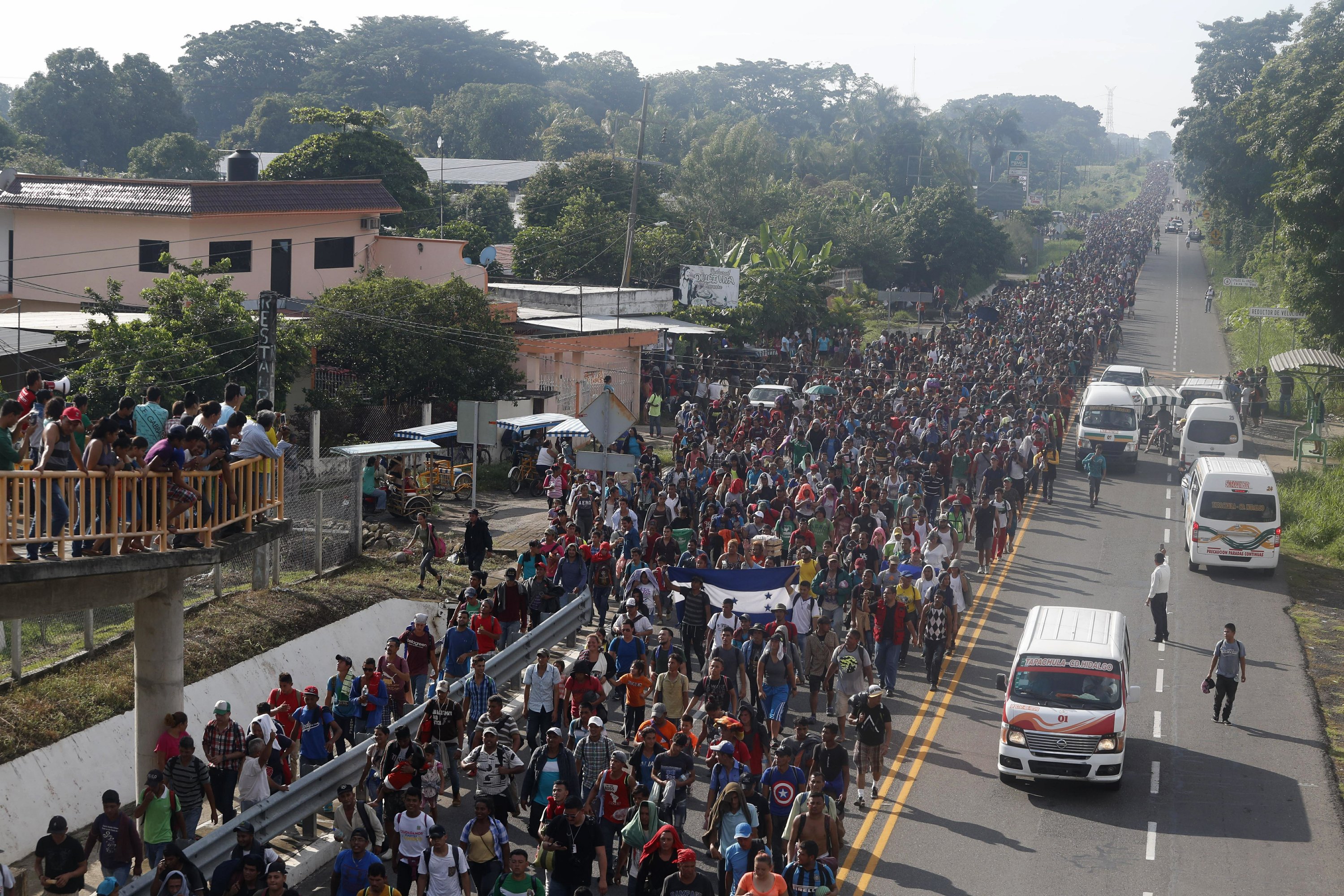
How Trump is Responding to the Migrant Caravan Situation


Background: https://www.nytimes.com/2018/10/26/world/americas/what-is-migrant-caravan-facts-history.html
Trumphttps://www.usatoday.com/story/news/politics/2018/10/25/donald-trump-migrant-caravan-asylum-restrictions-mexico-border/1769320002/


As of today, there are estimated 7,000 people traveling with the caravan (2300 of those are estimated to be children). This number is changing as people are dropping off due to illness or exhaustion, while others are joining as well. The caravan's big number attracts the attention of the Trump administration. The caravan consists of mostly Hondurans hoping to escape violence and poverty in their country, but other Central Americans have joined in smaller numbers as well. The people in the caravan are hoping to seek asylum. Initially, locals did not react positively to the caravan. As the migrants entered Mexico they were pushed back and tear gas was thrown. But now, as the migrants have advanced, they have been receiving more support, with residents preparing food and offering free rides. However, Trump does not have the same reaction. The Trump administration is looking for ways to "restrict or block outright [the caravan's] ability to enter the country" (Jackson). Options include sealing the border and "denying asylum applications based on the so called 'travel ban' of 2017" (Jackson). Trump has threatened to seal the border over Twitter. There is controversy over whether the travel ban is a legitimate exercise of executive power. Additionally, Trump is trying to use the caravan situation to his advantage in the midterm elections, hoping to energize the voters. It is said that if migrants do not have a legitimate reason to stay they will definitely be removed. These threats do not seem to deter migrants from leaving their country and journeying to the United States.

Do you think the Trump administration should seal the border? Why or why not?

There are arguments that the migrants could take refuge in Mexico, but they are still heading for the United States. This raises the question: What are there true motives? Are they just looking for refuge from the violence in their countries or is there another motive?

What do you think should be done to address this situation?


San Mateo County, California, Measure W, Roads and Transit Sales Tax (November 2018)


Measure W is a measure on the local ballot this November. This measure has raised questions about the allocations of funding to fix the issues of traffic congestion, road repair, and transit systems in San Mateo County. A yes vote on this measure would mean a vote in favor of implementing a 0.5% sales tax on all qualified retail transactions for 30 years beginning on July 1, 2019. This tax money would be used to fund road improvements on highways throughout the county, including 101 and 280, fund transit services (SamTrans, Caltrain, etc.), and to implement the San Mateo County Congestion Relief Plan. A no vote on this measure would mean voting against the sales tax. The measure on the ballot states that the implemented sales tax will provide “approximately $80 million annual that the State cannot take away”, meaning it will be regulated at the local level and therefore, theoretically, ensure that the money will reach our local level issues. However, citizens in San Mateo County are already paying state and federal level gas taxes, as well as recently increased bridge tolls, both of which are funds meant to be allocated to similar transit improvements. This measure proves to be controversial for San Mateo County voters: should there be a tax at the local level to fix local roads and programs, or should we rely on the already implemented state taxes. This issue stems from the overlapping responsibilities of the different levels of federalism.

  1. Are California's roads and transit systems more likely to be repaired by the local, state, or federal government? Why?
  2. Should the tax be implemented on all retail transactions, despite the fact that not everyone in the county uses the roads or services they’d be paying to fix?
  3. Do you think the measure will pass? Why?